
Research from Deloitte has noted that digital ecosystems increasingly create value through user interaction, ownership patterns, and virtual participation rather than through physical products alone. Inside many gaming communities, virtual items have gradually evolved beyond cosmetic objects and now behave more like assets with perceived value, social importance, and exchange activity.
Communities built around digital items often develop their own internal systems of value. Platforms and users establish ideas about rarity, demand, and utility that influence behavior. Some ecosystems also discuss concepts linked to item exchange systems and verification tools through sources such as provably fair MM2 coinflip games, reflecting broader conversations around transparency and digital interactions. Although these systems exist in entertainment spaces, their structure increasingly resembles economic activity.
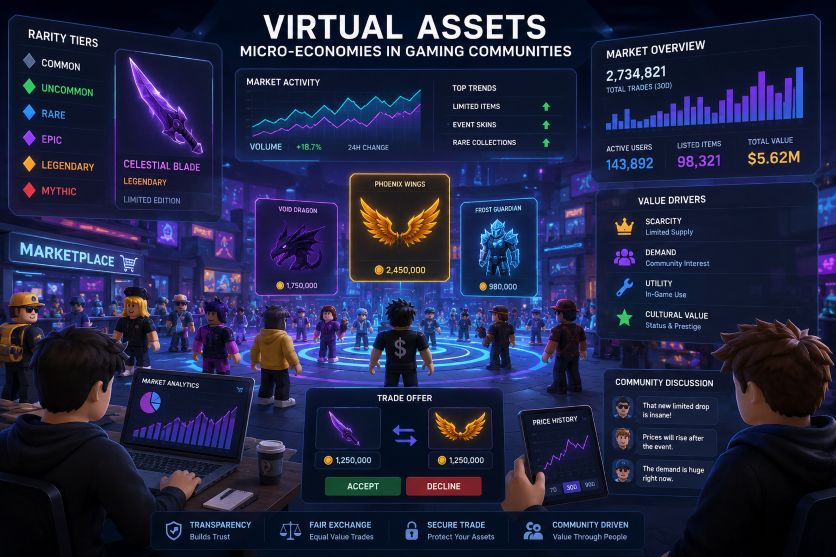
Emergence of Virtual Asset Ecosystems
Virtual items originally served a simple purpose. A skin, collectible object, or customized character element functioned as a way to personalize gameplay experiences. Over time, however, these assets started accumulating additional meaning.
Gaming communities introduced rarity tiers, limited releases, and event-based exclusives. Once scarcity entered these environments, user behavior began changing. People no longer viewed items purely as visual additions. Instead, items gradually became markers of identity and social standing.
Research published by the World Economic Forum has discussed how digital ownership continues reshaping online interaction models. While traditional economies revolve around physical resources, digital environments create systems where perceived scarcity drives engagement.
Communities often reinforce these systems naturally. Discussion forums, marketplace conversations, and social interactions can collectively influence how certain assets are valued. Even when developers do not intentionally design economic structures, communities frequently create them independently.
Perceived Value Creation
Studies from McKinsey & Company have suggested that value within digital environments often emerges from emotional and social factors rather than direct material utility. This observation helps explain why virtual assets sometimes begin functioning similarly to economic resources.
Unlike traditional objects, digital items have no physical limitations. Their value often comes from perception rather than production cost. A virtual item can become highly desirable because of rarity, community recognition, or cultural meaning inside a specific gaming ecosystem.
This process creates an interesting contradiction.
Critics sometimes argue that virtual assets possess no intrinsic value because they exist entirely within software environments. Others suggest that value itself has always depended partly on shared belief. Currency systems, collectibles, and certain luxury products have historically relied on collective agreement regarding worth.
This tension forms an important discussion point. One perspective views virtual items as temporary digital objects with limited significance outside specific platforms. The opposing perspective sees them as examples of evolving forms of ownership and value creation.
Reality appears to exist somewhere between those positions.
Communities establish rules and expectations that transform virtual objects into meaningful assets. Once enough users collectively recognize those expectations, small-scale economies can emerge.
Similarities to Financial Behavior
The behavior surrounding virtual assets often resembles financial activity in surprising ways.
People monitor supply trends. Users discuss changing demand patterns. Communities react to sudden increases in item popularity. Some individuals closely observe shifts in perceived value over time.
Research from the Organisation for Economic Co-operation and Development (OECD) has highlighted how digital markets increasingly mirror traditional economic behavior through user participation and network effects.
Financial systems and gaming communities clearly differ in important ways. Traditional financial markets involve regulation, institutional oversight, and broader economic consequences. Gaming ecosystems primarily exist within entertainment environments.
Still, behavioral similarities remain visible.
Limited digital inventories can produce scarcity concerns. Community reactions can influence perceived value changes. Emotional attachment sometimes shapes decisions as strongly as objective considerations.
Discussions surrounding virtual item ecosystems occasionally overlap with terms associated with MM2 game-based betting environments or item exchange systems, particularly when communities examine how digital assets move between users. These conversations demonstrate how entertainment environments increasingly intersect with broader ideas surrounding digital ownership and perceived value.
Human behavior may be the common thread connecting these systems. People naturally assign meaning to things they consider rare, socially important, or difficult to obtain.
Implications for Digital Economies
The growth of virtual micro-economies raises broader questions about future digital environments.
If communities can independently create functioning value systems around virtual assets, larger questions emerge regarding ownership rights, regulation, and long-term economic influence.
The International Monetary Fund has examined how digital environments and emerging technologies may influence future economic structures. Although gaming communities differ significantly from financial institutions, they provide useful examples of how users interact with value systems in online spaces.
Developers and policymakers may eventually face complex decisions regarding digital property and community-driven marketplaces. Questions about accountability, transparency, and consumer protection could become increasingly relevant as these systems continue evolving.
There are also social considerations. Strong emotional attachment to digital assets may affect user decision-making patterns in ways that resemble broader consumer behavior. Virtual environments increasingly occupy meaningful parts of everyday digital life.
Responsible engagement therefore becomes important. Activities involving item exchanges, chance-based systems, or virtual risk mechanisms may involve financial or psychological considerations. Discussions around financial literacy and responsible gambling practices increasingly emphasize understanding risk awareness and informed decision-making within digital environments. Users should approach these systems with moderation and awareness, particularly when real-world value becomes connected to online experiences.
Conclusion
Virtual assets are no longer functioning solely as decorative features inside gaming communities. They increasingly operate within systems shaped by collective perception, scarcity, and user interaction.
The debate surrounding these environments remains balanced. Some observers see temporary digital trends, while others recognize early examples of broader economic evolution. Both perspectives contribute useful insights.
As digital spaces continue growing, discussions surrounding virtual ownership and related MM2 digital wagering ecosystems may become part of larger conversations about online economies and user behavior. The larger lesson may not involve the assets themselves. Instead, it may reveal how people consistently create value systems wherever communities gather and shared meaning develops.
Risk Warning: Gambling-related activities and chance-based digital systems carry financial and behavioral risks. Participation should be approached responsibly and with awareness of personal limits.